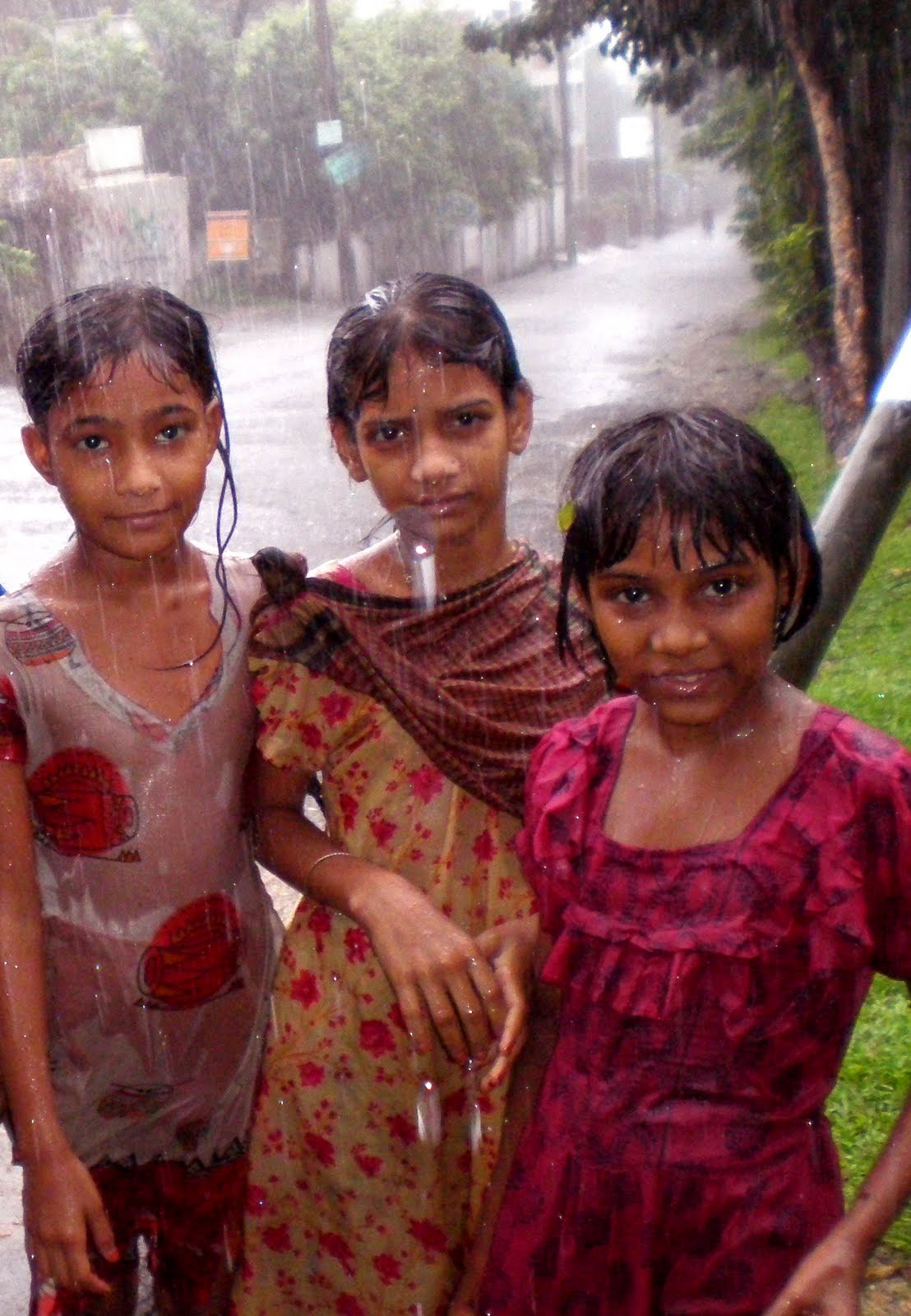
Wednesday, September 25, 2013
Saturday, December 29, 2012
people's land
Ei jomi kar? “Whose land is this?”
Manusher “People’s”
Our eleven year-old boat paddler on the Padma River replied
to my mother’s question very matter-of-factly, with confident authority. But I
sensed his answer was a little too simple, perhaps naïve, since it referred to
the land on the long-contested Bangladesh-India border.
We had rowed across the shrunken river and were standing on
a vast stretch of seemingly desolate wasteland – a sandbar that is completely
engulfed by the Padma in the wet season. Hence this temporary land is one of
very few wide-open, uninhabited spaces in Bangladesh. It isn’t wasteland,
though. As we walked along the so-called sandbar, a man nearby was spraying his
lentil crop – dal, said our boy.
Then as the sun began to descend, a long line of human forms
began to appear from the far unseen edge of the plain. They carried crops,
sacks, children, and all manner of things. Their day’s work was done – what work? I don’t know, but it results
from a commute that is only possible half of the year. Their forms grew larger
as they approached the river bank to cross back over to the unambiguous land of
Bangladesh. Shonar Bangla lit by an
orange cheese-ball sun.
----
I feel I’m about to cross a river, but still have a month of
sandbar. My contract at AUW finishes officially in two days, then a month of
traveling with my mom – Mymensingh, Bangladesh, then Thailand, Cambodia,
Vietnam. Other peoples’ lands.
I’ll land in New York on January 28th and I’m
excited to reach the other side and take in the shores of the jubilant sea of
Maine again, even if it means joining my countryfolk as we tumble over a fiscal
cliff. The world didn’t end on 12-21-12, but maybe a new era has begun.
----
For now, I’m blessed to be welcoming the New Year with my
parents – two amazing individuals who taught me to seek adventure, to laugh
through rough times, and to love people in every land.
Friday, August 31, 2012
proud in the mud (or "the surprising hibiscus")
This afternoon I was surprised by the sudden appearance of this pink hibiscus in my garden.
The flower-bed-lined balcony off the kitchen in my flat in South Khulshi is a sacred space. A sanctuary, especially at sunset and sunrise. I've done my best to keep the effect of my jet lag that allows me to fall soundly asleep by 9:30 or 10pm and be up by 5:30 or 6am, sipping coffee with my BCP on the balcony. I am exceedingly blessed to have this space and I'll be damned if I take it for granted.
That's why--when the green plants of my treasured green space began to wither and die last year--I hired a gardener for a day to doctor it up a bit. Tik koron, shundor koron. "Fix it, make it beautiful," was my simple plea, "Oh and rong lagbe, I need color!" With these simple directives the gardener disappeared out into Chittagong and returned hours later with pots of young green plants, good soil and a hose, and began operating on the parched beds. At the end of the day he assured me the colors would come. Flowers would come. Phul ashbe.
And they have. I went to the States for a month of the monsoons and I returned to plants twice the size of when I'd left. Every day a different plant blooms with a surprise blossom. Today it was the pink hibiscus.
This seems to happen on the streets of Chittagong too -- the sudden igniting of a tree that yesterday was green and today bursts with near-supernatural shades of red, orange, yellow, or fushia. Taking photos of the blossoms becomes addictive. A couple months ago I finally bought M.A. Taher's books, Bangladesher Phul and Bangladesher Pakhi, on the flowers and birds of Bangladesh. From the States I brought back a pair of binoculars--a Christmas present from my brothers--and I plan to try a hand at "birding" in the Chittagong hill tracts. For now, I'm using the flower book to identify my balcony surprises.
I came across this quote by Rabindranath Tagore on the first page of Bangladesher Phul.
"Phul bole, dhono ami matir pore."
Anyway, I'll update you if I get another translation.
Speaking of mud, while I was watering my pots (which I also sprinkle every morning with my used coffee grounds), I noticed the first sprouts of my sunflowers! The lovely Rebecca Clark sent me off from Maine to Bangladesh with sunflower seeds last summer (2011), and I failed my first growing attempt. That was also the year the whole garden died and the gardener was called in. My job kind of took over my life last year, and I'm committed to not letting that happen again. So I'm watering the sunflower seeds and doing my best to battle against the impetuous seed-eating ants.
I'm also growing basil and parsely -- first basil sprout below!
I could do a whole post devoted to the fragrances and odors of my life in Chittagong, and perhaps I will. A preview to that is the photo below, of the sweetest phul in my humble garden. I couldn't find the name for this one in my book, so I'll ask the gardener to enlighten me when he comes to advise me on the worsening ant crisis. Anyway, you can smell these tiny white blossoms from yards away and they'll take you to happy places in your mind.
I discovered from my book that the flowers below are called in Bangla, kathmaloti, or tagar, or officially, tabernamontana dichotoma of the apocynaceae variety.
And on the opposite side of my apartment, I look out my living room window at kash phul, or thatch grass. In the morning, a few cows and goats feed among these soft white heads of meadow grass that wave gently in the easterly breeze.
The scientific name for thatch grass is saccharum spontaneum, gramineae. The Latin is fantastic, isn't it? I'm sure one could find a way to live life by mottos based on floral nomenlature.
To end, I'll quote M.A. Taher's thoughts from his "Author's Words" in Bangladesher Phul:
Flowers may not be indispensable in our everyday life but we show our love for them in all our social functions. We welcome our guests and adorn the venue of our festive functions with colourful flowers. During Puja, flowers are essential. We show our love for our beloveds with a present of flowers. And the beauty of flowers satisfy our aesthetic urge. Again, the medicinal qualities of many flowers surprise us. But above everything else it is the beauty of flowers that gives us the greatest joy. Moved by the beauty of flowers poets have written poems, musicians have composed songs, artists have painted pictures. On the first of Falgun when spring arrives the sight of young women clad in yellow dress with garlands of beautiful flowers wound around the coil of their hair delights us.
Thursday, August 16, 2012
ramadan sirens
I awoke at 2:45am and lost my bookmark in whatever dream I may have been dreaming. Now it's 3:45 and I've given up on forcing myself back to sleep. I'll most likely regret this decision about twelve hours from now, but my remorse will be nothing that my Aeropress and some freshly ground espresso from North End can't fix.
I am back in Chittagong after a whirlwind five weeks in seven U.S. so this pre-sunrise insomnia can easily be blamed on the eleven-hour time difference and my thoroughly confused inner time-clock.
But the other factor that jolted me out of an apparently forgettable dream was a 2:50am siren, screaming over a load speaker adjacent to my building to wake up fasting families for their pre-dawn meal.
The holy month of Ramadan is drawing to a close in a few days, though I don't think we know for sure which day Eid ul-Fitr (the feast day marking the end of Ramadan) will occur. I believe the moon plays an integral role in this determination. So this week, Saturday, or Sunday, or maybe Monday, the 29 to 30 days of daylight fasting will end, and an epic party will ensue in every household.
(Note: I have no Eid ul-Fitr plans as of yet, so in case any Chittagonians are reading this, I am a huge fan of Shemai--the sweet milky goodness of that cardamom-infused vermicilli dessert traditionally served at this holiday in Bangladesh, and I promise I'm an easy guest.)
It's 4:00am and the second siren just called all full-bellied Khulshi-dwellers to wash their hands and prepare for about fifteen hours of fasting. Many will go back to sleep. But some of the men are now fitting their heads with their embroidered taqiyah caps and stepping out into the heavy, but somewhat cooler (85˚F) pre-dawn air to do namaz at the local mosque. An equally loud call to prayer - one of five per day - has followed the second siren.
I admire the visible existence of community during Ramadan. Everyone is waiting. Waiting together for newness. On Eid, devotees will pray before sunrise, then in following the Prophet's instructions, they will brush their teeth with a toothbrush and shower and wear new clothes and perfume. It is obligatory to show happiness on this day. There are many in this world who could use some obligatory genuine happiness. Bangladesh does this well, as I've been reminded several times in my three days back.
But there has also been a difficult side to my first week - this final week of Ramadan. The traffic and shopping are a nightmare -- probably no worse than Black Friday back home, but then again I'm in a city of over 5.5 million, and it seems everyone is shopping. But I can handle that. I can mostly avoid witnessing the American-like vice of chaotic overspending by hiding out in the peaceful safetly of my apartment. Rather, it's a virtue that I confess I have been resenting. The virtue of charity.
One of the main distinquishing features of Eid ul-Fitr is its emphasis on giving to the needy -- "as much charity as possible." As much as possible? Let's be honest -- I have eight more years to pay off college debt, so really, it's possible to pretty much empty my bank account, give away 80% of my earnings, and still eat my fill in this low cost-of-living environment. And it seems that every beggar in Chittagong has heard this little secret of my financial status. Everywhere I go, outstretched hands of skinny children, elderly adults, the blind, and crippled, and of healthy-looking men and women too, reach and grab and condemn me for my selfishness. But I can handle that. I console myself -- I'm a teacher. I donate to an NGO monthly with automatic withdrawal. Free handouts on the street perpetuate the cycle of poverty and unsustainable dependence. Blah blah blah...
What has been hardest is navigating the Eid baksheesh (gift money) for the people I know -- those who serve me daily in Bangladesh, whose faces and names I know. The guards at my office, the cleaners in my building, the cleaners that used to work in my building, the cleaner who works at my friend's building. These are people whom I know and relationships in which I delight, and so I have begun to convince myself that we are equal -- they help me practice Bangla, and I'm somehow involved in their employment -- let's not talk about money, that's uncomfortable for my Western sensibilities. But they're breaking my unwritten rule. They're asking for gifts, and it's making me uncomfortable. In my mind, there exists only one context in the world in which it's completely okay to ask for a gift or money -- and that's little Joey asking Dad for field-trip spending cash or a new gargoyle action figure.
When these non-offspring acquaintances of mine ask for monetary gifts -- or even worse -- inform me that they'll be needing a larger gift than I've given, my instinct is to say -- Well, now I don't want to give it. It's not out of the goodness of my big wonderful heart anymore. If you hadn't asked for it, I would have given it joyfully...
But would I have?
Probably not. I probably would have forgotten about the apu (elder sister) who quietly empties my garbage can each day and hand-mops my apartment block's stairway while I'm at work. She wouldn't have to drop hints about the upcoming holiday if she were working for families of the Bangladeshi religious majority rather than a building full of unaware expats. Although I am bothered by the assumption that my skin color automatically signals wealth, not a day goes by in Chittagong in which I don't feel exceedingly blessed by the comfort of my life.
So maybe today I should decide to appreciate the helpful reminders from those whom I'm sure I have forgotten as carelessly as I forgot the characters of my siren-interrupted dream. Perhaps I should be obligatorily happy in my giving and see if genuine joy arises.
The sun has risen now and this city will soon be hungry. Waiting for the iftar feast, for charitible gifts, and for newness and mandatory happiness. Eid Mubarek!
I am back in Chittagong after a whirlwind five weeks in seven U.S. so this pre-sunrise insomnia can easily be blamed on the eleven-hour time difference and my thoroughly confused inner time-clock.
But the other factor that jolted me out of an apparently forgettable dream was a 2:50am siren, screaming over a load speaker adjacent to my building to wake up fasting families for their pre-dawn meal.
The holy month of Ramadan is drawing to a close in a few days, though I don't think we know for sure which day Eid ul-Fitr (the feast day marking the end of Ramadan) will occur. I believe the moon plays an integral role in this determination. So this week, Saturday, or Sunday, or maybe Monday, the 29 to 30 days of daylight fasting will end, and an epic party will ensue in every household.
(Note: I have no Eid ul-Fitr plans as of yet, so in case any Chittagonians are reading this, I am a huge fan of Shemai--the sweet milky goodness of that cardamom-infused vermicilli dessert traditionally served at this holiday in Bangladesh, and I promise I'm an easy guest.)
![]() |
| Shemai |
It's 4:00am and the second siren just called all full-bellied Khulshi-dwellers to wash their hands and prepare for about fifteen hours of fasting. Many will go back to sleep. But some of the men are now fitting their heads with their embroidered taqiyah caps and stepping out into the heavy, but somewhat cooler (85˚F) pre-dawn air to do namaz at the local mosque. An equally loud call to prayer - one of five per day - has followed the second siren.
I admire the visible existence of community during Ramadan. Everyone is waiting. Waiting together for newness. On Eid, devotees will pray before sunrise, then in following the Prophet's instructions, they will brush their teeth with a toothbrush and shower and wear new clothes and perfume. It is obligatory to show happiness on this day. There are many in this world who could use some obligatory genuine happiness. Bangladesh does this well, as I've been reminded several times in my three days back.
But there has also been a difficult side to my first week - this final week of Ramadan. The traffic and shopping are a nightmare -- probably no worse than Black Friday back home, but then again I'm in a city of over 5.5 million, and it seems everyone is shopping. But I can handle that. I can mostly avoid witnessing the American-like vice of chaotic overspending by hiding out in the peaceful safetly of my apartment. Rather, it's a virtue that I confess I have been resenting. The virtue of charity.
One of the main distinquishing features of Eid ul-Fitr is its emphasis on giving to the needy -- "as much charity as possible." As much as possible? Let's be honest -- I have eight more years to pay off college debt, so really, it's possible to pretty much empty my bank account, give away 80% of my earnings, and still eat my fill in this low cost-of-living environment. And it seems that every beggar in Chittagong has heard this little secret of my financial status. Everywhere I go, outstretched hands of skinny children, elderly adults, the blind, and crippled, and of healthy-looking men and women too, reach and grab and condemn me for my selfishness. But I can handle that. I console myself -- I'm a teacher. I donate to an NGO monthly with automatic withdrawal. Free handouts on the street perpetuate the cycle of poverty and unsustainable dependence. Blah blah blah...
What has been hardest is navigating the Eid baksheesh (gift money) for the people I know -- those who serve me daily in Bangladesh, whose faces and names I know. The guards at my office, the cleaners in my building, the cleaners that used to work in my building, the cleaner who works at my friend's building. These are people whom I know and relationships in which I delight, and so I have begun to convince myself that we are equal -- they help me practice Bangla, and I'm somehow involved in their employment -- let's not talk about money, that's uncomfortable for my Western sensibilities. But they're breaking my unwritten rule. They're asking for gifts, and it's making me uncomfortable. In my mind, there exists only one context in the world in which it's completely okay to ask for a gift or money -- and that's little Joey asking Dad for field-trip spending cash or a new gargoyle action figure.
When these non-offspring acquaintances of mine ask for monetary gifts -- or even worse -- inform me that they'll be needing a larger gift than I've given, my instinct is to say -- Well, now I don't want to give it. It's not out of the goodness of my big wonderful heart anymore. If you hadn't asked for it, I would have given it joyfully...
But would I have?
Probably not. I probably would have forgotten about the apu (elder sister) who quietly empties my garbage can each day and hand-mops my apartment block's stairway while I'm at work. She wouldn't have to drop hints about the upcoming holiday if she were working for families of the Bangladeshi religious majority rather than a building full of unaware expats. Although I am bothered by the assumption that my skin color automatically signals wealth, not a day goes by in Chittagong in which I don't feel exceedingly blessed by the comfort of my life.
So maybe today I should decide to appreciate the helpful reminders from those whom I'm sure I have forgotten as carelessly as I forgot the characters of my siren-interrupted dream. Perhaps I should be obligatorily happy in my giving and see if genuine joy arises.
The sun has risen now and this city will soon be hungry. Waiting for the iftar feast, for charitible gifts, and for newness and mandatory happiness. Eid Mubarek!
Thursday, June 21, 2012
mangos
I took this photo in May while I was visiting my parents up north in Rajshahi. Rajshahi is mango country, and mango season is just beginning.
Mangos.
I love them. They're appearing everywhere now, piled high in the fruit shops with a fragrance sweet and bold enough to mask even the open sewer's foul punches. Everywhere now, lining the sidewalks where men sit cross-legged with paring knives, ready to open the ripe flesh to prove the quality to any doubting buyer, they're calling out, "Langra aam! Fusli aam!" Aam, mango. Mmm.
As I dreamed about mangos at my desk today, my mind re-encountered a childhood memory. I must have been about seven years old, somewhere in Bangladesh with more trees than buildings. Not Chittagong. Walking along a shaded path one afternoon between monsoon showers, I saw a discarded mango pit lying on brown earth that the rains had patted firm like clay. And from this carelessly tossed mango pit a tiny tree was sprouting. I bent down and examined the tiny roots, pushing their way into the hard earth. A mango tree was growing. Just like that.
When later on I learned the word "fertile," I allowed the memory of that mango pit on Bangladesh's soil to be the image that captured the meaning of that word for me.
You are a fertile country, Bengal. Your monsoon rains are coming, and your mangos are ripening. Bengal, Oh Mother mine, as Tagore sang, the fragrance from your mango groves drives me wild with joy.*
---------
*From "Amar Shonar Bangla," written by Rabindranath Tagore, eventually adopted as Bangladesh's national anthem.
Thursday, February 23, 2012
Nazma
Jodi amar ma mure gelo, amar keu nai...
"If my mother dies, I'll have no one..."
Tears welled up in Nazma's eyes, and this spunky, fiery 18 year-old suddenly looked much smaller, sitting on the other side of my desk. She had sunk into the chair from which my students ask questions about analysis versus evaluation, but for Nazma's questions this morning, I had no "teacher's" answer. "Amar ma beshi oshusto." -- "My mother is very sick," she was explaining. "Yesterday, we went to the doctor. They did many tests. We don't know what's wrong.... Please pray for her. I have no one besides my mother. I'm alone. I have no one besides my mother." She repeated those words as round tears slid down her soft, dark cheeks.... amar keu nai...
Nazma is not a student, as her uniform of black trousers, an oversize red polo shirt, and a black scarf clearly indicate. She sweeps and mops the buildings where girls her age spend the days in classrooms and dorms, weaving big dreams. They'll be the "future leaders of Asia" according to our AUW mission. They dream of starting NGOs, becoming policy writers, lawyers, scientists, activists, presidents.... Nazma sits at my desk hoping that her mother will make it through the year. This dream is now eclipsing her own dreams for education. She wonders why she can't be learning at AUW, rather than washing it's grimy dishes. This question bothers me too...
Nazma's father died when she was three or four. Last year her house burned down, taking with it years and years of dowry savings. She is the youngest of several siblings who are all married now.
Nazma is smart. She was solely responsible for securing high-paying cleaning jobs in AUW professors' apartments for her two sisters and her brother's wife. She is constantly networking and negotiating, usually on behalf of others. She is spirited and generous, but can also be pushy and demanding, which has paid off immensely for her family. But she is still tremendously vulnerable as an unmarried, uneducated woman in Bangladesh. I find myself avoiding that haunting question, "Why was this her fate and not mine?" Or I spin some pacifying answer such as, "I'm teaching young women of Asia so that they can change the situation of the Nazmas in their communities." But right now I just feel dully speechless.
I move to Nazma's side of the desk, put my arm around her small shoulders and say, "You have us, you're not alone. You have brothers and sisters..."
She answers, Bhaibon, tomra... Mar motto na... "They're not like a mother. No one is like Mother. She is everything."
There's nothing I can say. I tell Nazma I'll pray. I can't even imagine going about today the way she has to, wondering what she will hear from the doctor this afternoon when she collects the results of the tests. She knows they won't be good... I've met Nazma's mother -- when she was relatively healther. And even then, she looked frail far beyond her years. I remember thinking she was a grandmother.
"Don't you have class today?" Nazma asks me.
"Yes, at 8:30."
"Kaj koro," she tells me to get back to work.
"Korbo. I will." Before she leaves, I pull out a little book of my students' writings that we compiled last week. I give Nazma a copy and tell her that my students had written about their relatives' love stories. We open up the first page to a sweet little story written by a Vietnamese student about her aunt and uncle. Nazma reads it beautifully, and I translate a few words here and there, but overall am stunned by the ability of this young woman who was forced to quit education before high school.
The story makes us smile, and at least for a moment we have forgotten the fear of death, anger at injustice, and the sadness that silenced us a few minutes ago. Nazma picks up a broom and I pick up a red pen and we reassume our roles.
"If my mother dies, I'll have no one..."
Tears welled up in Nazma's eyes, and this spunky, fiery 18 year-old suddenly looked much smaller, sitting on the other side of my desk. She had sunk into the chair from which my students ask questions about analysis versus evaluation, but for Nazma's questions this morning, I had no "teacher's" answer. "Amar ma beshi oshusto." -- "My mother is very sick," she was explaining. "Yesterday, we went to the doctor. They did many tests. We don't know what's wrong.... Please pray for her. I have no one besides my mother. I'm alone. I have no one besides my mother." She repeated those words as round tears slid down her soft, dark cheeks.... amar keu nai...
Nazma is not a student, as her uniform of black trousers, an oversize red polo shirt, and a black scarf clearly indicate. She sweeps and mops the buildings where girls her age spend the days in classrooms and dorms, weaving big dreams. They'll be the "future leaders of Asia" according to our AUW mission. They dream of starting NGOs, becoming policy writers, lawyers, scientists, activists, presidents.... Nazma sits at my desk hoping that her mother will make it through the year. This dream is now eclipsing her own dreams for education. She wonders why she can't be learning at AUW, rather than washing it's grimy dishes. This question bothers me too...
Nazma's father died when she was three or four. Last year her house burned down, taking with it years and years of dowry savings. She is the youngest of several siblings who are all married now.
Nazma is smart. She was solely responsible for securing high-paying cleaning jobs in AUW professors' apartments for her two sisters and her brother's wife. She is constantly networking and negotiating, usually on behalf of others. She is spirited and generous, but can also be pushy and demanding, which has paid off immensely for her family. But she is still tremendously vulnerable as an unmarried, uneducated woman in Bangladesh. I find myself avoiding that haunting question, "Why was this her fate and not mine?" Or I spin some pacifying answer such as, "I'm teaching young women of Asia so that they can change the situation of the Nazmas in their communities." But right now I just feel dully speechless.
I move to Nazma's side of the desk, put my arm around her small shoulders and say, "You have us, you're not alone. You have brothers and sisters..."
She answers, Bhaibon, tomra... Mar motto na... "They're not like a mother. No one is like Mother. She is everything."
There's nothing I can say. I tell Nazma I'll pray. I can't even imagine going about today the way she has to, wondering what she will hear from the doctor this afternoon when she collects the results of the tests. She knows they won't be good... I've met Nazma's mother -- when she was relatively healther. And even then, she looked frail far beyond her years. I remember thinking she was a grandmother.
"Don't you have class today?" Nazma asks me.
"Yes, at 8:30."
"Kaj koro," she tells me to get back to work.
"Korbo. I will." Before she leaves, I pull out a little book of my students' writings that we compiled last week. I give Nazma a copy and tell her that my students had written about their relatives' love stories. We open up the first page to a sweet little story written by a Vietnamese student about her aunt and uncle. Nazma reads it beautifully, and I translate a few words here and there, but overall am stunned by the ability of this young woman who was forced to quit education before high school.
The story makes us smile, and at least for a moment we have forgotten the fear of death, anger at injustice, and the sadness that silenced us a few minutes ago. Nazma picks up a broom and I pick up a red pen and we reassume our roles.
Tuesday, February 21, 2012
Eleanore Godfrey Thorpe
Here I am again, sheepishly returning to this blog that I've left abandoned since October for no reason other than my lazy surrender to these eyes that are so tired of computer screens.
However, I daily berate myself for missing the opportunities to pen stories of Bhaktapur's temples in Nepal, of village treks in Bangladesh's hill tracts, scuba diving on Thai islands, or even of the rare luxury of a decadent sushi feast in Dhaka.
Four minutes from midnight, now is not the time to impart those tales. Instead, I've come to share a couple past writings about a woman I have been remembering often this month. My grandmother, Eleanore Thorpe, would have turned ninety-one on the 3rd of Februray this year -- the same day as my brother David's birthday.
![]() |
| The kitchen walls of our Christmas Cove house, painted by Eleanore Thorpe |
As a Valentine's Day assignment with my students last week, I asked them to narrate their grandparents' or parents' courtship in a paragraph. The vignettes that poured in from Afghanistan, Vietnam, Sri Lanka, and Bangladesh were sweet and sappy in all the best ways. Even Eleanore (Bammie as we called her) – who used to call Valentine's and Mother's Day "ploys of the card companies" – even she would have loved the justice my students did to this Hallmark-monopolized holiday.
I, too, responded to the assignment I'd given my students, and the following story of my grandparents' early encounters was the result:
Gardner Public Library
In brown leather heels and a blue cardigan, my youthful grandmother Eleanore Godfrey sat shuffling through Dewey Decimal cards when she first saw him. The sharp man with a distinctive nose was a regular book borrower, but his weekly visits fell outside of Ellie’s normal working hours. So the sly young librarian switched shifts with another in hopes of wooing this man. At a party, they were introduced. When asked whether they’d met before, my grandmother stood tall on her classy leather pumps, smiling, beaming, waiting to hear this John Thorpe speak her thoughts, Why yes, we know each other from the––“No, I don’t believe we've met,” my grandfather’s voice interrupted Ellie’s narration. Hopes crushed. Memories dissolved. All those times she’d stamped his books much too slowly; or how she’d been sure to catch his eyes upon her refrain, “Due in two weeks, unless you renew.” Nevertheless, not long after he learned her name, she’d won his affections. The next year, she stood at his side, with a triumphant smile, in new white heels.
![]() |
| John & Eleanore on the porch of the Christmas Cove house |
![]() |
| Eleanore is not pictured in this drawing my my brother, Benjamin, but the tall fellow in the back is our grandfather John Thorpe, Sr. – back in his theatre days. |
The Gardner library incident was one of two favourite stories I've cherished of Bammie since childhood. The other was about the time she spent a full day removing seaweed from her beach only to have it wash up again the next day. A few years ago, I included this story in a composition for a creative non-fiction course, when my professor posed the simple, yet infinitely broad question,
What would you change?
...I would recover the house over-looking Sand Cove.
My grandmother Eleanore Godfrey Thorpe used to make “friendship doughnuts” and sell them for eighty cents per dozen to fishermen and local families in Christmas Cove. A nickel of those eighty cents went to my dad, the delivery boy. Hardly school-aged, he could maneuver the dingy through the crowded summer harbor, avoiding precariously hidden ledges marked carefully on every seaman’s chart of John’s Bay. After a few summers of deliveries to loyal customers, my Bammie, called Ellie by all who knew her, had saved enough money to buy a cottage over-looking the small beach that had been given to her as a gift.
Some years later, Eleanore sold the cottage she had bought with doughnut money. It was the same way with most of my ancestors’ land in Christmas Cove—properties were bought and sold through the years, until finally, the extended Thorpe family today shares just one house. I love the solid, white, unassuming frame of the Thorpe house. It is old enough to tell stories from long before the Civil war, and to contain the secret of my grandfather’s birth, and of how he lived upstairs in the room with a tiny door. It is our family’s house. The doughnut cottage had been Ellie’s.
If I could go back a couple decades and change Bammie’s mind—tell her that her cottage was worth keeping, I would not hesitate to state my opinion. Ellie, I’m told, never hesitated to withhold hers on any matter, especially politics. I like to think that during my more stubborn moments, I am a living piece of my grandmother. She stomped her small brown high-heeled shoe down when folks put forth unsubstantiated assumptions. Like when they denied the beauty of her beach.
I skip stones at the beach in every season. It’s still in the family, and we will always call it Bammie’s Beach, even though everyone else has been calling it “Smelly Beach” as long as my father can remember. An all-too-natural stench often pervades, as mounds of seaweed wash onto the sand and rocks at high tide, baking in the sun, and refusing to recede with the bowing waves.
Dad told us how once, Bammie spent the whole day packing the dry, pungent seaweed into garbage bags and loading it onto Pappy’s truck to be taken away from her gem-habitat. The next morning the beach was covered again, as if over the night, arms had reached out from the small cove to recover from the ocean the brown and green shreds of clothing. The rags been stripped off by a small woman who wanted to prove that underneath it all, her beach was beautiful and pure.
Bammie was probably content to sell the cottage because her real treasures were always the sand, rocks, and water outside of walled houses. As much as she might have enjoyed the rainy day task of bathing the cottage with the sugary warmth of dozens of friendship doughnuts, she was more herself when removing truck-loads of salty seaweed from a misty beach at dawn.
Still, I wish she had kept the cottage. It would not have changed my life, I suppose, and there are much greater and more urgent things to be addressed, overthrown, reformed in the world. Yet as I walk along Bammie’s beach now, I look up to the east at the cottage and imagine that if I could only escape behind its small windows, make some doughnuts perhaps, or watch for the little boy in the dingy—that maybe it would be a place where I could think quietly about those bigger changes to make, territories to explore, fears to conquer. Other things I could leave the way they are meant to be—like the seaweed on the beach, and the memory of Bammie before the Alzheimer’s. Of my grandmother when she was Ellie.
| Skipping stones at Bammie's beach |
Saturday, October 22, 2011
colors that keep me going
I used to keep a blog.
It was about life in Chittagong, Bangladesh -- about experiences at the Asian University for Women, and happenings on the streets, and meals in hospitable homes, and escapes to the rural beauty of this shonar (golden) Bengal. Writing was a necessary escape too -- a chuti (vacation) that was healthy and therapeutic, along with cooking. Since taking a new, more intense position at AUW as director of the academic EFL program in which I taught last year, neither cooking nor writing have received enough of my attention. So I'm going to write this post, then bake some Irish soda bread.
I suppose it has only been two months since I last wrote, but my writer's block would suggest it has been much longer. Just to get myself back into it, I'm going to keep my musings simple today: I'm going to praise the vibrant colors that have been my drug this year. Doses of orange, teal, coffee, and grass are a visual therapy more easily obtained than a five-course meal or a page of prose.
ORANGE:
I went to Dhaka recently and finally bought one of the kantha blankets made by Hand and Cloth (please check out this wonderful business). Kantha is the traditional Bangladeshi design of a two-sided blanket made from vintage sari cloths. In Dhaka, I was spending the weekend with my friend who began Children's Uplift Programme, for homeless women and children in Dhaka. I had visited CUP a bit over a year ago and the women who were then just learning to sew kantha, as an alternative to the risks and abuses of street work, are now empowered by their livelihoods at Hand and Cloth. I bought my kantha blanket at North End Coffee roasters in Dhaka, and perhaps for the first time in my life, I strayed from my tendency to buy blue and green bedding, and I went for orange and red. I'm very happy with that decision.
DARK ROAST BROWN:
For me the drug of coffee is not solely in the caffeine, but in the entire sensory experience from the rich color of the beans, to the fragrance released while grinding, to the hot mug in my hands that gently draws me out of sleepy comas. North End Coffee Roasters has transformed the coffee addict's experience of life in Bangladesh. Started by Rick Hubbard it is the first and only coffee roasting company in Bangladesh. They're now delivering to Chittagong upon request, so every couple weeks or so I put in an order from AUW professors and a nice man named Monir shows up in a rickshaw at my apartment building with bags of coffee beans.
TEAL:
Soon, I'll write more about apartment 7-A in South Khulshi, but for now let's establish that I'm quite enamoured by this place I'm blessed to call home. The living room colors practically jump to greet me every time I enter, no matter how wilted I am. With some teal cushions picked out by my roommate Fatema, and an orange Pakistani cloth I picked up at a fair last year, we had our accent colors established. Coffee brown woods and tan sofa cushions provide the canvas for the spots of sea and sun.
GRASS GREEN
Finally, as long as there is daylight in South Khulshi, our hill outside needs no assistance in expressing it's audaciously perfect green flora. I see it outside my window when I wake up, and from the living room when I'm typing emails on a grey screen. Green. It's the color Bangladesh does best.
It was about life in Chittagong, Bangladesh -- about experiences at the Asian University for Women, and happenings on the streets, and meals in hospitable homes, and escapes to the rural beauty of this shonar (golden) Bengal. Writing was a necessary escape too -- a chuti (vacation) that was healthy and therapeutic, along with cooking. Since taking a new, more intense position at AUW as director of the academic EFL program in which I taught last year, neither cooking nor writing have received enough of my attention. So I'm going to write this post, then bake some Irish soda bread.
I suppose it has only been two months since I last wrote, but my writer's block would suggest it has been much longer. Just to get myself back into it, I'm going to keep my musings simple today: I'm going to praise the vibrant colors that have been my drug this year. Doses of orange, teal, coffee, and grass are a visual therapy more easily obtained than a five-course meal or a page of prose.
ORANGE:
I went to Dhaka recently and finally bought one of the kantha blankets made by Hand and Cloth (please check out this wonderful business). Kantha is the traditional Bangladeshi design of a two-sided blanket made from vintage sari cloths. In Dhaka, I was spending the weekend with my friend who began Children's Uplift Programme, for homeless women and children in Dhaka. I had visited CUP a bit over a year ago and the women who were then just learning to sew kantha, as an alternative to the risks and abuses of street work, are now empowered by their livelihoods at Hand and Cloth. I bought my kantha blanket at North End Coffee roasters in Dhaka, and perhaps for the first time in my life, I strayed from my tendency to buy blue and green bedding, and I went for orange and red. I'm very happy with that decision.
DARK ROAST BROWN:
For me the drug of coffee is not solely in the caffeine, but in the entire sensory experience from the rich color of the beans, to the fragrance released while grinding, to the hot mug in my hands that gently draws me out of sleepy comas. North End Coffee Roasters has transformed the coffee addict's experience of life in Bangladesh. Started by Rick Hubbard it is the first and only coffee roasting company in Bangladesh. They're now delivering to Chittagong upon request, so every couple weeks or so I put in an order from AUW professors and a nice man named Monir shows up in a rickshaw at my apartment building with bags of coffee beans.
TEAL:
Soon, I'll write more about apartment 7-A in South Khulshi, but for now let's establish that I'm quite enamoured by this place I'm blessed to call home. The living room colors practically jump to greet me every time I enter, no matter how wilted I am. With some teal cushions picked out by my roommate Fatema, and an orange Pakistani cloth I picked up at a fair last year, we had our accent colors established. Coffee brown woods and tan sofa cushions provide the canvas for the spots of sea and sun.
Finally, as long as there is daylight in South Khulshi, our hill outside needs no assistance in expressing it's audaciously perfect green flora. I see it outside my window when I wake up, and from the living room when I'm typing emails on a grey screen. Green. It's the color Bangladesh does best.
Sunday, August 14, 2011
Sri Lanka
As the sun rose over what have been called the “killing fields” of Sri Lanka, I fought to keep my eyes opened and focused on the scenes rushing past the window of my bus to Jaffna.
The journey here had been a long one so far - as most in South Asia admittedly are. The third term of teaching English in the Access Academy at AUW had come to a close the 14th of July, at which point Ms. Christa’s desk contents were emptied into a box that I’ll reclaim in three weeks. My apartment was vacated, and I was off to Dhaka, and from there to the northwest to visit my parents. After a delightful three-day visit in Rajshahi, the seven-hour Pabna Express brought me back to Dhaka, where I boarded a bus to Kolkata with one of my Sri Lankan students, Aara. We crossed the Bangladesh-India border by foot, completing necessary paperwork and successfully avoiding payment of bribes, then resumed the bus journey taking us to the massive railway station in Kolkata, where we crammed ourselves and our luggage into a cozy little birth for a thirty hour journey south to Chennai. From Chennai, we hopped over an insignificant portion of the Indian ocean on an airplane that landed us in Colombo, Sri Lanka. I spent a fantastic afternoon with my other Sri Lankan student, Nima, cartwheeling along the “Gold Face” - the impressive stretch of beach along the capital’s western border.
Before meeting Aara and Nima in my classroom one year ago, I would not have thought it any significant utterance to refer to them both equally as ‘Sri Lankans’. At least not until Aara enlightened me one Thursday afternoon in my office, exclaiming, “Ma’am, I have never thought to call myself ‘Sri Lankan” - because my identity was as a ‘Tamil girl’. But here in Bangladesh, for the first time, I am ‘Sri Lankan’ and so is Nima - but I have never before been friends with a Sinhala girl...”
These two young women - from the two ethnic groups that have been engaged in civil war for 26 of Sri Lanka’s 39 short years since independence - forged a deeply inspiring friendship at AUW. Not merely symbolic, it was genuine, and as one who has little reference for what post-war reconciliation means, I might never understand what degree of strength this action of the two students actually took.
I will not try to give a history of the struggle between the Liberation Tigers of the Tamil Eelam (LTTE) and the Sinhala-majority government military (Sri Lankan Army - SLA), although if you're ignorant as I was a year ago, please take some time to learn. A controversial documentary by the UK’s Channel 4, with footage of the undeniably atrocious war crimes was produced recently and strongly opposed by Sri Lanka's government. The war narrative has many sides and is worth studying, if we ever hope to learn from our grave human errors. (See a BBC link here.) Some of the events that led to the devastating climax of the fighting in early 2009 too closely match those that preceded the Rwandan genocide of ’94. And it is not by error that the designation “Killing fields of Sri Lanka” echoes the memory of events during the horrific rule of Cambodia’s Khmer Rouge.
With Aara’s warning that we were now entering the lands in which the majority of fighting took place, I began intently scanning the horizon. For the first few miles, there was simply nothing to see. But this emptiness, and total abandonment of such a great expanse of land on such a little island, was strange and disconcerting. Actually, the land was nearly empty, save for government’s soldiers patrolling the roads, but at five in the morning, these were the only human presence. The camouflage uniforms made me recall the checkpoint we’d encountered around 2am, at which point I'd been asked to exit the bus with my passport, and provide the army officers with some photos and my letter of invitation. I was interviewed briefly, and a form was filled out with my personal information, after which the satisfied guards dismissed their groggy visitor.
Aara pointed out the bullet-ridden and bombed out buildings, voicing her surprise that they hadn’t all been torn down yet. “The government doesn’t want it to look like there was a war here,” she explained. Understandable, I thought, but is it still somehow insensitive? I tried to read Aara’s face for her sentiment on this matter but I sensed her mind was consumed with other thoughts and memories - those of an insider.
We passed many cows. In India, I had joked with Aara about how the way you can tell that you’ve crossed from Bangladesh into India is by the look of the cows - skinny and sad in Bangladesh, where they’re kept for a while then served up at a Muslim feast, but fat and proud in India, where they’re revered by Hindus as sacred beings. Aara pointed to the cows of Hindu Jaffna and remarked, “But see ma’am, even the cows here are skinny, because after the war, not all of the owners returned, so many animals just wander.”
Soon we came upon an area I had dreaded seeing, for the confirmation it would supply for how repulsive humans at war can be. “Land mines,” said Aara, gesturing toward the yellow tape marking off many acres of deadly territory. She had written in her final essay about the discrimination faced by Tamil war widows in the northern and eastern parts of Sri Lanka. As part of her evidence for how social norms have so ostracized this vulnerable sub-population, she provided stories of the widows who have all-too-willingly volunteered to take jobs as land-mine sweepers.
It was hard to avoid painting upon this landscape the gruesome images of 2009 that I’d seen portrayed on the Channel 4 documentary some months before. The actual scene before me was quite benign, but little things stood out - like the posters of the smiling Sinhala president plastered upon every building, here in this defeated Tamil town.
And I noticed how all the houses being erected in the process of rebuilding northern Sri Lanka were all being made from the same prototype. A little song about the creation of the first American suburban neighborhoods suddenly popped into my head… little boxes on a hillside...made of ticky-tacky, little boxes, little boxes, little boxes all the same.
That bus ride from Colombo to the north was the only time during my week in Sri Lanka that we dwelt on the sad, surreal quality of the post-war state. As we saw the first signs of approaching Aara’s seaside town of Point Pedro, my student brightened up at the joyful thought of seeing her family for the first time in a whole year. The sun rose high in the sky that day, and by evening time we were carefree swimmers in a clear blue sea.
Tuesday, June 21, 2011
The monsoons have returned
Ahead is a long exerpt of an old college essay about the Bangladeshi origins of my obsession with water (feel free to bail out, as it gets quite off the topic of monsoons)...

Water
Throughout my childhood, the monsoon rains of Bangladesh drenched a third of my memories each year. My brothers and I loved the rains. Far from sending us indoors, hands gripping the windows' metal bars, the rain was a friend beckoning us to play. The weather was not merely an arbitrary addition to our normal games. Instead, we focused the entire afternoon's play around our wet guests -- the "waterfalls" created by the roof's draining pipes, the deep puddle in the indentation between the football goal stones, the seemingly bottomless wells of the rain-filled oil barrels -- we named them all, and remembered their names even after their several month hiatus during the dry season.
Perhaps the arrival of the fresh clean rain puddles seemed so right and necessary because of what covered the streets in between the cleansings. During the Islamic festival of Eid, following the holy month of Ramadan, my brothers competed with their friends Chris and Jonathan Adkins to compare the depth of puddles on the grounds outside our houses. These pools, however, depended not on rain clouds as their source, but drew from the hanging carcasses of sacrificial goats and cows slaughtered outside every gate in Mohammadpur. Looking into the opaque scarlet blood puddles on my walks to school in the morning, I could not see the reflection of a smiling freckled face. It did not occur to me then that dead animals and blood pools, or crippled beggars and street kids, would not have been images included in my childhood had I spent its entirety in Maine.
When I was seven, I once stumbled upon a dead baby next to the dumpster across from Suzie Adkin's house. It was a "hartal" day -- the frequent occurence of a nation-wide strike in Bangladesh, when the roads are cleared of motor vehicles. On these days, David, Benjamin, and I were allowed to roller-skate freely on the streets. This particular afternoon, Benjamin was crouching incomspicuously behind the rear rubber tires of a rickshaw, holding onto the painted portrait of a Bollywood star. My brother's trick was to catch a free, exhilerating pull on his skates when the rickshawallah began peddling off in search of passengers. Upon noticing that his apparently empty carriage had resisted him by thirty extra kilograms, the man would begin a cruel (but probably justified) game of peddling fast with shart twists, turns, and jolts, attempting to disengage the non-paying parasite from his rickshaw. I was admittedly not as brave nor quite as mischievous as my elder brother, so on this day, I skated away from his dangerous game.
I noticed that the crows had dragged something from the trash pile to the street. I saw the small doll-like form and curiously came to it, scattering the black crows back to their telephone wires to watch greedily over Iqbal Road. She was a very small brown baby, face-down, with tiny fingers. I remember standing over her, unstable on my red skates, frozen and staring for a short while. Later, at home, I told my mother. Mom said the baby was probably still-born, and I guessed she had belonged to the family in the make-shift dwelling across from Suzie's house. I was sad, but I couldn't cry. I went home and washed my hands and face for dinner.
In the next rainy season, my reflection in the monsoon puddle between the football goal stones showed a different child from the year before. Grow a little, and both a little more aware, and more unsure. Increasingly, the images of the suffering afround me came to hold distinct frames in my memories. In the back of my mind developed a fear that I would become calloused and indifferent. I looked back on the images hoping for a glint of meaning, and I was faced with opaqueness, like the street blood, which never returned a satisfying reflection of the clouds, trees, or faces looming above.In June of 1995, my brothers and I peered excitedly out of a small ovular window at the shadow of our jet moving over Maine's Casco Bay in the final minutes of our journey back to a home we hardly remembered. We gawked at the fascinating foreign land below, with the dark blue water, tiny sailboats, and funny pointed-roof houses.
I was about to re-meet my grandparents, and was a little ashamed of the band-aid still stuck on the bridge of my nose. I touched the little plaster reminder of the first of many memorable swimming accidents I would experience in my life (though non managing to dissuade me from that fantastic sport). Only hours before leaving Dhaka, my family had taken our last trip to the American Club pool. Who knew how long it would be before we returned to Bangladesh? So I had made up my mind -- this was my last chance to attempt the brilliant swimming trick that I had seem performed by an especially cool teenage girl at the pool on numerous occasions. Not until joining swim team my last year of high school would I learn that this swimming skill was called a "flip-turn." After three years of studying my anonymous role model in the act, I believed the moment had come for me to imitate. So, as a farewell to the pool where I had learned to swim, I kicked my legs and moved my arms as Dad had taught me, approaching the pool's edge, and attempted my first flip-turn. I over-rotated and my nose met the metal ladder.
I'm sure it looked worse than it was. I remember crying at my own blood dripping onto my hands. A man ran to me, extending his clean white handkerchief. Seeing how, without hesitation he had sacrified it to be stained by a stranger made me cry all the more. I didn't try another flip turn for almost ten years.I did keep swimming though. That summer of 1995 I began my love affair with Maine and her waters. Almost every day between Memorial Day and Labor Day, my dad piled us into the blue Plymouth Voyager to drive to the Mills, as everyone called the favorite Damariscotta Lake swimming spot. While Mom read under the crab apple tree, Dad would swim out to the small island a half mile into the lake. Year after year, one of the most anticipated summer activities for Damariscotta kids was jumping off the green bridge into the fresh sun-warmed water.
One time at the Mills, I jumped off the bridge and hit a boat.
It could have been avoided. I should have hear the horn warning sounded by the young couple taking their joy ride in a white motor boat. The image of the boat below me has seared my memory because of its shocking effect. Every other time that I've jumped off that bridge, I have been aware of my own relfection coming toward me from below. Usually, my falling body and the joyfully waving arms and legs of my reflection meet in the ecstatic explosion of water displaced by our union. On that day though, my reflection was not below me, and this unexpected turn of events threw me into a frantic confusion. I tried to fly. I moved my arms, as if in water, but physics had already determined that my mass was no match for the air compared to the control I'm given in water. So, rather than into my reflection, I found myself staring for a split second into the petrified faces of a young man and woman who were just as panicked as I. My foot, then my thigh, hit against the pointed bow of the white boat and I bounced off into the water, where I scrambled fast toward shore.
All was fine. I was only bruised, and the boat-owner has probably since suffered more stress around bridges than I ever will. I always knew that it could have turned out much worse, and as it went, it made better story than had it all been avoided.....My relationship with water has evolved as all romances do. I finally learned how to perform flip-turns, how to teach various physics-informed swimming strokes to kids at summer camp, and how to rescue a drowning victim in deep or shallow water. I have learned that the surface tension property of water is responsible for capillary action, moving nutrients through our tiny blood vessels. I habitually drink the recommended two liters of water per day. I swim to the island with my father in our Maine summers. David skillfully rigs the Eleanore in the harbor; Benjamin and I marvel at our younger brother's navigation around the ledges of John's Bay as he controls the angle of the sail against the wind. I have learned more about rain shadows, marine biology, coastal contamination, and tidal patterns than ever crossed my mind in those early years of becoming enamored by puddles and seas.
Still, there's much to be learned, and today I am compelled to continue reaching and listening, not always confident of which way to look or move. God in nature seems less knowable but more enticing than ever before. Images of suffering and memories of dead babies often leave me staring into a pictureless pool. The ancient voice of the ocean is sometimes silent also.In the summer of '07, I leaned backward off a small motor-dingy at a diving site near the Perhentian Islands off the coast of Malaysia. With a regulator in my mouth attached to an oxygen tank so I could breath, a mask sealed around my face so I could see, and fins on my feet so I could move, I dropped back and broke the surface of the water. I relaxed my body and, taking a few deep breaths, bobbed upright for a moment contemplating the marvelous task ahead of me. I would leave this realm of gravity's inescapable pull, and take my own supply of air, defying nature to sink twenty meters beneath the surface of the South China Sea. I began to descend, deeper and deeper until the time came to neutralize my position in the water. The pressure had compressed the air in the flotation attached to my wetsuit and I began to sink faster. With my left index finger, I pressed a button to release air from my tank into the floatation and my sinking came gently to a stop. I rolled forward, face-down, and stretched so my body was parallel to the flat sandy substrate. And in that quiet blace, I breathed slowly, completely suspended by the water, not rising, not sinking, just resting, and waiting.
Wednesday, May 25, 2011
Longing for the Annapurnas
Although the challenging climbs and breath-taking views were undoubtedly the apex of my week's vacation, the other major highlight included the time of rest at the Hotel Courtyard in Kathmandu. Run by a wonderfully generous couple named Pujan and Michelle, the Courtyard is truly a place of homecoming for weary travellers and teachers alike. Tanja Cesh had stayed there on and off for a month last October and highly recommended it to me. When I walked in and told Michelle, "You know my friend Tanja," she immediately welcomed me like a sister. Tanja was a popular guest here, for obvious reasons. Accomodation in Nepal is unbelievably inexpensive. We could have stayed comfortably in the heart of the busy tourist district Thamel for just a few dollars a night. Although with the Courtyard you pay more (came to about $28 per night per person), it was and is worth every penny. A true oasis in a smoggy developing-world city. Also, they have a lovely dog.
Our last evening in Kathmandu, we had planned to celebrate my friend Alyssa's birthday, but she was feeling a little under the weather. Pujan mentioned to me that another guest at the Courtyard, Chris Beale (British mountain photographer and 27-year Nepal expat), was to give a slideshow of the landscape and cultures of the Annapurnas. I replied that it sounded like a good way to enjoy Alyssa's birthday, and Pujan immediately insisted that all we needed to do was show up at the slideshow, and "the grilled steak, champagne, and birthday cake" would be his treat! One thing I should mention, that ties into all this, is that Alyssa has read Jon Krakauer's Into Thin Air about five times, and was re-reading it while we were in Nepal. That very evening in the cozy library at the Courtyard, with a thunder storm accompaniment to a delicious Austrailian steak meal, we ended up dining with three Everest summiteers. The most prominent of these was Argentinian Willie Benegas (of the Patagonian Brothers) who has summitted Everest 10 times and has completed all of the Seven Summits at least twice. His identical twin brother Damian had once personally funded and undertaken a rescue operation on Everest when a woman posted on the internet that she had not heard from her father in a few days since he'd ascended that ruthless height. Alyssa had read this story in the New York Times in 2008 and happened to remember the name Benegas, so sharing birthday cake with Willie was a pretty fantastic and serendipitous birthday gift.
Nepal.
In Kathmandu people had told us, "You don't come here just once. You'll come back."
Well, if my third conjecture is true -- if indeed a part of me is still somewhere in the Himalayan foothills -- then yes, I believe she will summon me again to her bask in her light and rest in her shadows, and I will gladly accept.
p.s. Photo credit to John Stanlake, and many thanks for the donation.
Subscribe to:
Posts (Atom)